


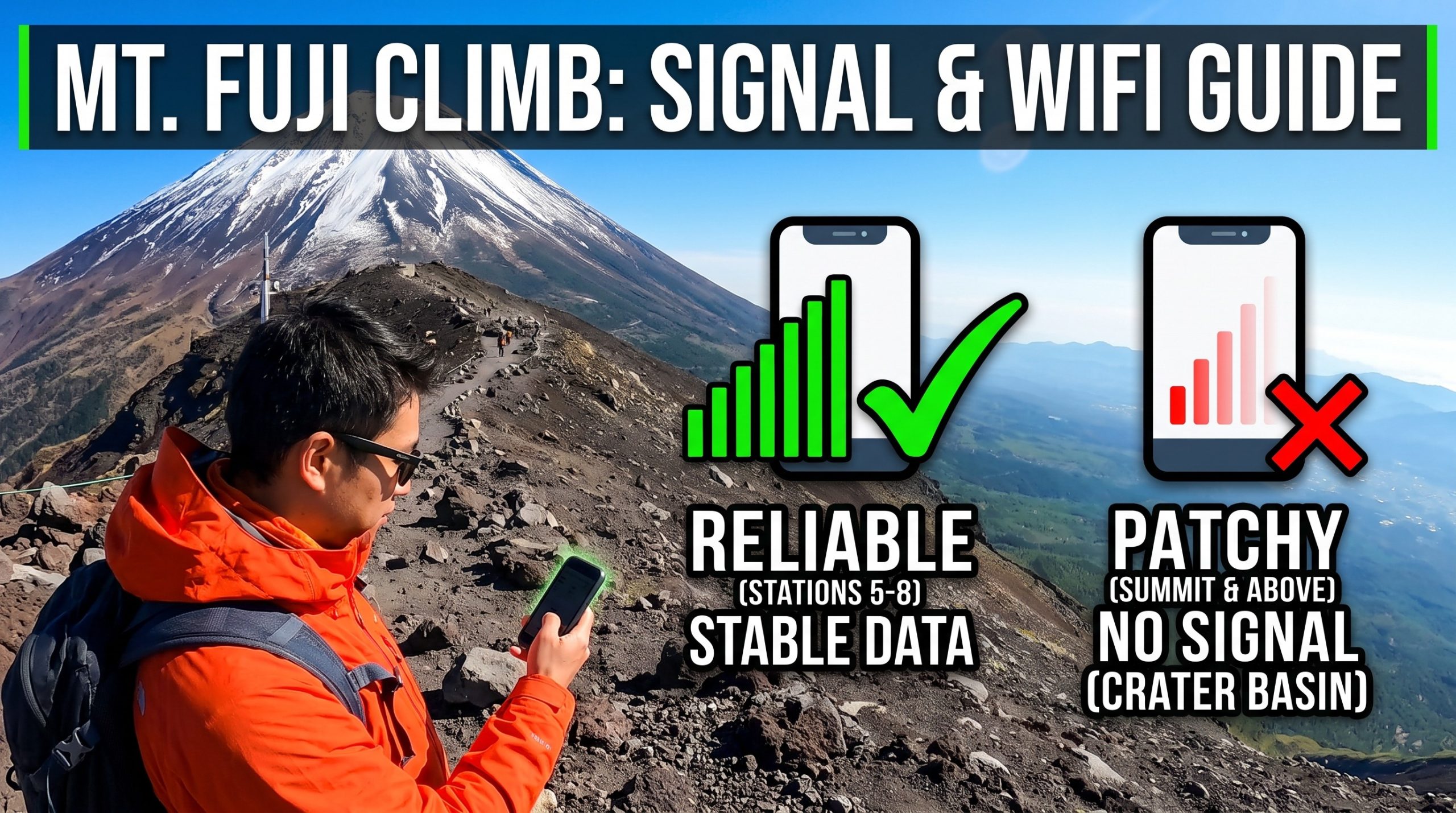
Pocket WiFi and mobile data on the Mount Fuji climb work reliably up to the 5th Station (2,305 m on the Yoshida trail), stay usable with intermittent drops between the 5th and 8th stations, and become unreliable from the 8th station (3,100 m) to the 3,776 m summit. All four Japanese carriers — NTT Docomo, SoftBank, KDDI (au), and Rakuten — have expanded 4G LTE coverage on the Yoshida trail in recent seasons, but signal depends on which side of the mountain you are on, weather, and how many climbers are pinging the same tower.
Japan Wireless Pocket WiFi runs on SoftBank 4G LTE, which matches the network most climbers report as usable to the 8th station on Yoshida. Above that, expect gaps at the traverses and inside the mountain huts built into rock faces.
Coverage by station on the Yoshida trail
The Yoshida trail from Subaru Line 5th Station is the most-climbed route and has the best signal profile.
- 5th Station (2,305 m): Full 4G LTE on all carriers. Free WiFi at the Fujisan Komitake Shrine rest houses and some souvenir shops.
- 6th Station (2,390 m): Stable 4G LTE.
- 7th Station (2,700–2,900 m): Usable 4G LTE at most huts; drops on switchbacks between huts.
- 8th Station (3,100–3,400 m): Intermittent. Signal returns near huts (Taishikan, Hakuun-so, Gansomuro), drops on the ascent traverse.
- Original 8th Station / 9th Station (3,600 m): Patchy. Text and messaging apps work in short bursts; video calls fail.
- Summit (3,776 m): Intermittent line-of-sight signal. Works enough to send a photo to LINE or WhatsApp, not enough for streaming.
The Subashiri, Gotemba, and Fujinomiya trails have less consistent coverage because fewer towers point at their approaches.
Pocket WiFi vs eSIM vs free WiFi on Mount Fuji
| Option | Cost | Coverage on Fuji |
|---|---|---|
| Japan Wireless Pocket WiFi (Unlimited) | ¥5,208/2 days | SoftBank 4G LTE, works to 8th station, patchy above |
| Ninja WiFi (5G Unlimited) | ¥2,200/day base + ¥110–200/day power bank | SoftBank 4G/5G, similar footprint, Fair Usage throttling possible |
| Ubigi eSIM | ¥1,200 for 3GB | Depends on host carrier; usable but data cap hits fast if you photo-share |
| Airalo eSIM | ¥700 for 1GB | Same carrier dependency; 1GB is thin for a 2-day climb |
| Free mountain hut WiFi | ¥0 | Not standard; a few huts offer paid WiFi at check-in only |
A pocket WiFi has one practical edge on Fuji: it can share signal with 10 devices, so a group of four climbers pays ¥1,067 per person for a 2-day rental (¥4,267 ÷ 4) and everyone stays reachable. An eSIM only covers the phone it’s installed on.
What to plan for above the 8th Station
Battery drains faster in cold air. Japan Wireless devices are rated up to 18.5 hours in normal conditions; at 3,000+ m in pre-dawn temperatures that can drop below 0°C during the July–September climbing season, expect noticeably shorter runtime. The free power bank included with every Japan Wireless rental matters here — Ninja WiFi charges ¥110–200/day extra for the same accessory.
Download offline maps (Google Maps offline area, or Maps.me) before you leave the 5th Station. GPS itself works everywhere on the mountain without a data connection; only the map tiles need to be pre-cached.
If you’re climbing to see the goraiko (sunrise from the summit), don’t count on a live video call home. A text message or a single photo upload is realistic; anything more is not.
Where to pick up a pocket WiFi before climbing
Most Fuji climbers arrive via Tokyo. Japan Wireless pickup points relevant to a Fuji itinerary:
- Haneda Terminal 3: 3rd floor, shared counter with Ninja WiFi, 6:30–23:00 daily
- Narita Terminal 1: JAL ABC counter, South Wing 1F, 6:30 to 1 hour after the last flight
- Narita Terminal 2: JAL ABC counter
- Hotel or Airbnb delivery in Tokyo, Kawaguchiko, or Fujiyoshida: ¥500 via Japan Post, next-day if booked by 3:00 PM JST
Return the device by dropping the prepaid Japan Post envelope in any postbox — including at a Lawson or on your way back through the airport.
Frequently Asked Questions
Does mobile data work at the summit of Mount Fuji?
Mobile data works intermittently at the 3,776 m summit — enough to send a photo or text on LINE or WhatsApp, but not for video calls or streaming. All four Japanese carriers (Docomo, SoftBank, au, Rakuten) have some line-of-sight coverage at the summit crater during climbing season, but the signal drops out in the crater basin and between huts on the final ascent.
Which trail on Mount Fuji has the best WiFi and mobile coverage?
The Yoshida trail from Subaru Line 5th Station has the strongest 4G LTE coverage of the four Mount Fuji routes. It’s the most climbed (about 60% of summit-goers use it), has the most huts, and the tower footprint from the Kawaguchiko/Fujiyoshida side reaches most of the ascent. Subashiri, Gotemba, and Fujinomiya trails have thinner coverage above the 7th station.
Is there free WiFi at Mount Fuji 5th Station?
Yes, free WiFi is available at several shops and rest houses at the Subaru Line 5th Station (2,305 m), including near Fujisan Komitake Shrine. Above the 5th Station, free WiFi is not standard — some mountain huts offer WiFi to overnight guests only, and it is not guaranteed. Bring a pocket WiFi or eSIM if you need connectivity higher up.
Will a pocket WiFi battery last the full Mount Fuji climb?
Japan Wireless pocket WiFi devices are rated for up to 18.5 hours, which covers a standard 5–8 hour ascent, but cold above 3,000 m shortens runtime. A Fuji climb often runs 10–14 hours including summit rest and descent, so bring the included free power bank. Ninja WiFi charges ¥110–200 per day for a power bank; Japan Wireless includes it at no extra cost.
Can I use free WiFi from Lawson or Starbucks near Mount Fuji?
Yes — Lawson stores in Fujiyoshida, Kawaguchiko, and Gotemba offer LAWSON_Free_Wi-Fi (60 minutes per session, 5 sessions per day), and Starbucks in Kawaguchiko offers at_STARBUCKS_Wi2 for 1 hour per session with unlimited reconnects. These are useful before you start climbing but do not extend up the mountain. 7-Eleven, FamilyMart, and Ministop no longer provide their own free WiFi.
Should I rent pocket WiFi or buy an eSIM for a Mount Fuji trip?
For a group climbing Mount Fuji together, pocket WiFi is cheaper per person; for a solo climber staying under 3 GB, an eSIM is cheaper. Japan Wireless 2-day Unlimited costs ¥5,208 and connects up to 10 devices — ¥1,067 per person for four climbers. Ubigi 3GB is ¥1,200 for one phone; go over and you’re throttled at the worst possible moment.