

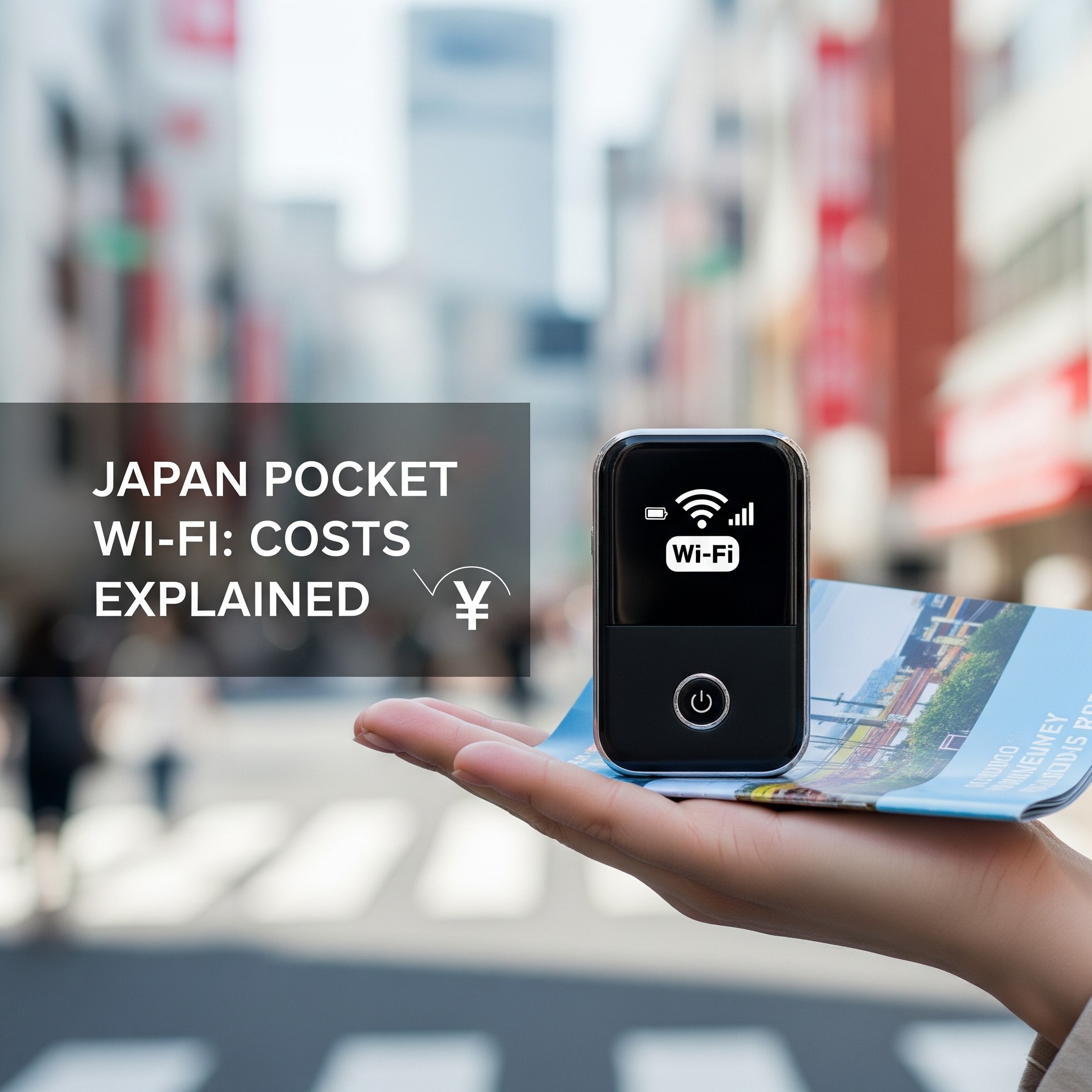
Pocket WiFi in Japan costs between ¥440 and ¥4,064 (~$2.95–$27 / €2.65–€24) per day. The range is wide because the daily rate drops sharply the longer you rent, and because different providers price very differently. For a typical 7 to 14-day trip, the realistic total is ¥4,000 to ¥20,000 (~$27–$133 / €24–€120) before add-ons.
The number you see on the homepage is almost never the number you pay. Most providers advertise their cheapest rate: which is usually based on a 30-day rental: and the actual cost for a 7-day trip is considerably higher. This guide breaks down what you actually pay: daily rates, total cost by trip length, the fees that do not show up until checkout, and when pocket WiFi works out cheaper than the alternatives.
Exchange rates used throughout: ¥150 = $1 USD / ¥167 = €1 EUR (June 2026)
Pocket WiFi Prices in Japan: Quick Answer
Average Daily Cost by Plan Type
| Plan type | Daily cost | Best for |
|---|---|---|
| Budget unlimited (e.g. Ninja WiFi base) | ¥440–¥600 (~$2.95–$4.00 / €2.65–€3.60) | Light users, short trips |
| Standard unlimited 4G | ¥700–¥1,200 (~$4.65–$8.00 / €4.20–€7.20) | Most tourists, families |
| Premium unlimited / 5G | ¥1,000–¥1,500+ (~$6.65–$10.00+ / €6.00–€9.00+) | Heavy users, remote workers |
| Japan Wireless (1 day) | ¥4,064 (~$27 / €24) | Single-day rental |
| Japan Wireless (30 days) | ~¥695/day (~$4.65 / €4.15) | Long-term stays |
Japan Wireless publishes $3.6/day as its base rate. Ninja WiFi starts from ¥440/day. Both prices are for longer rentals: the 7-day rate will be higher. Prices verified June 2026.
Estimated Total Cost by Trip Length
| Trip length | Estimated total (base rental only) | Notes |
|---|---|---|
| 3 days | ¥3,000–¥6,000 (~$20–$40 / €18–€36) | Minimum rental fees often apply on short bookings |
| 7 days | ¥4,000–¥9,000 (~$27–$60 / €24–€54) | Most common tourist trip |
| 10 days | ¥6,000–¥12,000 (~$40–$80 / €36–€72) | Good benchmark for international visitors |
| 14 days | ¥8,000–¥20,860 (~$53–$139 / €48–€125) | Daily rate drops noticeably at the two-week mark |
| 30 days | ¥13,000–¥30,000+ (~$87–$200+ / €78–€180+) | Long-term plans vary widely by provider |
Japan Wireless 14-day example: approximately ¥12,430 (~$83 / €74) without discount; ¥9,944 (~$66 / €60) with coupon code JPW001. Verify at checkout: promotions change.
These figures are base rental only. Delivery, insurance, power bank, and accessories add to the total. See the hidden fees section below.
When Pocket WiFi Works Out Cheaper Than the Alternatives
Travelling with two or more people. One router split between three people costs roughly a third of what three individual eSIMs would. At ¥1,000/day for the router split three ways, each person pays ¥333 (~$2.20 / €2.00) per day.
Using multiple devices. A router handles phones, tablets, and laptops at once. An eSIM only covers the phone it is installed on. Tethering from a phone works but drains the battery fast.
Phone is carrier-locked. If your US carrier has locked your phone, eSIM installation may not be possible. Pocket WiFi connects to any device with WiFi, regardless of carrier lock status.
Avoiding roaming charges. AT&T International Day Pass: $10/day (~¥1,500/€9). Verizon TravelPass: $12/day (~¥1,800/€11). Two weeks on either carrier costs $140–$168 (~¥21,000–¥25,200 / €126–€151). Pocket WiFi for the same period typically runs $53–$139 total, split between everyone sharing it.
One important caveat on carrier roaming: the speed is often throttled after a daily data threshold even on the paid international plans. AT&T International Day Pass gives you the same data speeds as your domestic plan, but Verizon TravelPass can throttle after 500MB on some plan tiers. Check the terms before assuming your carrier plan works as expected abroad.
Japan Pocket WiFi Price by Rental Period
The longer you rent, the lower the daily rate. That is true across all providers, not just Japan Wireless.
1–6 Days
Short rentals are expensive per day. Japan Wireless charges ¥4,064 (~$27 / €24) for a single day. Shipping or airport pickup fees take up a larger proportion of the total on short bookings. If you are travelling alone for three or four days, an eSIM will almost certainly be cheaper. For a couple or family on the same trip, pocket WiFi can still make sense once the shared cost is factored in.
7–14 Days
This is where pocket WiFi earns its place for most travellers. Daily rates drop to ¥700–¥1,200 (~$4.65–$8.00 / €4.20–€7.20) in this range. A 14-day rental from Japan Wireless comes to approximately ¥12,430 (~$83 / €74) before any discount, or ¥9,944 (~$66 / €60) with JPW001.
Two weeks in Japan means heavy daily use. Google Maps for every train connection and every unfamiliar street. Google Translate at restaurants, pharmacies, and convenience stores. Booking apps for last-minute changes. If you hit a data cap at 14:00 in Kyoto and your speed drops to 128kbps, Google Maps stops loading tiles. That is not a theoretical problem: it happens, and it is genuinely disruptive.
For a couple sharing one router on a 14-day trip, the per-person cost works out to roughly ¥4,965–¥6,215 (~$33–$41 / €30–€37) each. That is less than a single day of US carrier international roaming.
15–30 Days
At this duration, the daily rate drops significantly. Japan Wireless at 30 days works out to approximately ¥695/day (~$4.65 / €4.15). Worth considering for anyone moving between multiple cities, working remotely, or arriving before their accommodation has a fixed connection.
30+ Days
Stays beyond 30 days move into monthly pricing territory. Japan Wireless prices 30-day rentals at ¥20,860 (~$139 / €125). Before committing, confirm whether the provider allows extensions without cancelling and rebooking from scratch.
At this duration it is also worth comparing against long-term local SIM options. Pocket WiFi makes sense if you are moving between cities or hotels frequently. If you have a fixed address and a stable internet connection at home, a local SIM or eSIM long-term plan may work out cheaper month-to-month.
What Affects the Price of Pocket WiFi in Japan?
The Daily Rate and How It Is Advertised
The headline rate is almost always based on the longest available rental. A provider advertising ¥440/day for 30 days might charge ¥900/day for 7 days. Calculate the actual total for your specific dates before comparing providers.
Unlimited vs Truly Unlimited Data
This is the most important thing to check. “Unlimited” means different things depending on who is selling it.
Truly unlimited means no daily cap and no speed reduction. Japan Wireless falls into this category.
Fair Usage Policy (FUP) unlimited means high-speed data up to a daily threshold, then speeds drop to 128kbps until midnight. Ninja WiFi operates on a “best effort” system that can reduce speeds under heavy load. At 128kbps, Google Maps will not load. Neither will most booking apps.
Fixed daily data means a set GB per day with service ending at the cap.
For solo tourists using maps and messaging, 3GB/day is usually enough. For groups sharing one connection, or anyone on video calls, the FUP becomes a real problem.
Number of Devices
Most routers support 5–15 simultaneous connections. Japan Wireless supports up to 15 devices. The more devices connected at once, the more the battery drains and the more the available bandwidth is divided. Practical performance is best with 4–6 devices actively in use at the same time.
For a family of four with two smartphones, one tablet, and one Nintendo Switch, the router handles all four without any noticeable speed reduction during normal use. It is only when multiple people are simultaneously streaming video or downloading large files that shared bandwidth becomes a constraint.
4G vs 5G
5G routers cost roughly 30–50% more. For the vast majority of tourist use: maps, translation, social media, video calls: 4G LTE is more than fast enough. 5G is only worth the premium for remote workers uploading large files or anyone doing live video streaming in high definition.
Rental Period Discounts
A 5-day rental might cost ¥5,000 total. The same plan for 10 days might cost ¥7,000. Check whether long-term discounts apply automatically or require a coupon code at checkout.
Hidden Fees to Check Before You Book
The advertised daily rate is never the full cost. Here is what gets added at checkout.
The providers most likely to catch you off guard are the ones with the most aggressively marketed daily rates. A ¥440/day headline often excludes a mandatory shipping fee, a power bank add-on you need anyway, and optional insurance you probably should have. By the time you reach the checkout total, the “cheap” option has often closed the gap with providers that include everything in the base rate.
| Fee type | Typical cost | What to check |
|---|---|---|
| Shipping / hotel delivery | ¥500–¥1,500 (~$3.35–$10 / €3.00–€9.00) | Is airport pickup free? Is the return envelope prepaid? |
| Insurance / damage protection | ¥100–¥300/day (~$0.65–$2.00 / €0.60–€1.80) | What does it cover? What is the excess? |
| Power bank rental | ¥110–¥300/day (~$0.75–$2.00 / €0.65–€1.80) | Japan Wireless includes this free. Ninja WiFi does not. |
| Late return fee | Typically daily rate + penalty | What happens if your flight is delayed? |
| Device replacement | ¥20,000–¥30,000+ (~$133–$200+ / €120–€180+) | Without insurance, losing the device is expensive |
Delivery and Return
Some providers charge for hotel delivery or airport post office pickup. Japan Wireless includes a prepaid return envelope: you drop it in any Japan Post red letterbox, including at airport departure terminals before security. Ninja WiFi uses airport counter returns and return drop boxes.
Insurance
A lost or damaged router costs ¥20,000–¥30,000 (~$133–$200 / €120–€180) to replace. Daily insurance at ¥100–¥300 covers this for a fraction of that cost over a 14-day trip (¥1,400–¥4,200 / ~$9–$28 / €8–€25). Worth adding if you are travelling with children, moving between multiple cities, or doing any outdoor activities.
Power Bank
Japan Wireless includes a power bank free with every rental. Ninja WiFi charges ¥110–¥200/day (~$0.75–$1.35 / €0.65–€1.20) as a paid add-on. Over a 14-day trip, that is ¥1,540–¥2,800 (~$10–$19 / €9–€17) extra. Add this to Ninja WiFi’s total before concluding it is cheaper than Japan Wireless: on longer trips the gap narrows considerably once the power bank is included.
Late Return
If you miss the return deadline, you pay for additional days. For Japan Wireless, return is by Japan Post letterbox: you can post it at the airport, at any convenience store, or at a street postbox. Post it before you clear security on departure day, not after.
Pocket WiFi for Families, Groups, and Heavy Users
Per-Person Cost When Sharing
| Number of travellers | Daily router cost | Cost per person per day |
|---|---|---|
| 1 person | ¥1,000 (~$6.65 / €6.00) | ¥1,000 (~$6.65 / €6.00) |
| 2 people | ¥1,000 (~$6.65 / €6.00) | ¥500 (~$3.35 / €3.00) |
| 4 people | ¥1,000 (~$6.65 / €6.00) | ¥250 (~$1.65 / €1.50) |
A family of four buying individual eSIMs at ¥2,480 per person for the week spends ¥9,920 (~$66 / €59) total. Sharing one pocket WiFi for the week costs approximately ¥7,000–¥9,000 (~$47–$60 / €42–€54): comparable or cheaper, with one password and one device to manage instead of four separate eSIM configurations.
Groups That Split Up
One router cannot cover people in different locations. If half the group goes to a different part of the city and takes the router with them, the other half has no connection. For groups that regularly separate, the options are: rent a second router, or give the party that splits off a cheap eSIM as a backup. Either way, factor this into the cost comparison before booking.
Streaming, Video Calls, and Remote Work
Hotel WiFi in Japan is inconsistent. Fast in business hotels, sometimes poor in budget accommodation, and always shared across all guests. If you are on video calls during the day or working from cafés, a dedicated pocket WiFi with truly unlimited data is the more reliable option. Hitting a FUP cap at 128kbps mid-Zoom call is not workable.
For remote workers, the practical test is simple: if a bad connection costs you a client call or a deadline, the price difference between a capped and an uncapped plan is irrelevant. Japan Wireless at ¥9,944 (~$66 / €60) for two weeks with JPW001 is less than a single lost billable hour for most freelancers.
Pocket WiFi vs eSIM vs SIM Card vs Roaming: Which Is Cheaper?
| Option | Estimated cost for 14 days | Best for | Main drawback |
|---|---|---|---|
| Pocket WiFi | ¥8,000–¥20,000 (~$53–$133 / €48–€120) total | Groups, multiple devices | Extra device to carry and charge |
| eSIM | ¥5,000–¥18,000 (~$33–$120 / €30–€108) per person | Solo, compatible unlocked phones | Cannot share; phone must be unlocked |
| Physical SIM | ¥5,000–¥12,000 (~$33–$80 / €30–€72) per person | Older unlocked phones | SIM swap required; no sharing |
| Carrier roaming | $140–$168 (~¥21,000–¥25,200 / €126–€151) total | Business trips (expenses paid) | Most expensive by a significant margin |
Solo travellers with an eSIM-compatible unlocked phone: an eSIM is usually cheaper. Plans start from approximately ¥2,480 (~$17 / €15) for a week. The eSIM installs via QR code before you leave home, activates when you land, and you never have to carry anything extra. For a solo traveller doing maps, messaging, and occasional photo uploads, it is the simpler and cheaper choice.
The exception is heavy data use. If you stream video, make daily video calls, or upload large files, the gap between eSIM plan tiers and a truly unlimited router narrows quickly. At that point the router is worth the extra device in your bag.
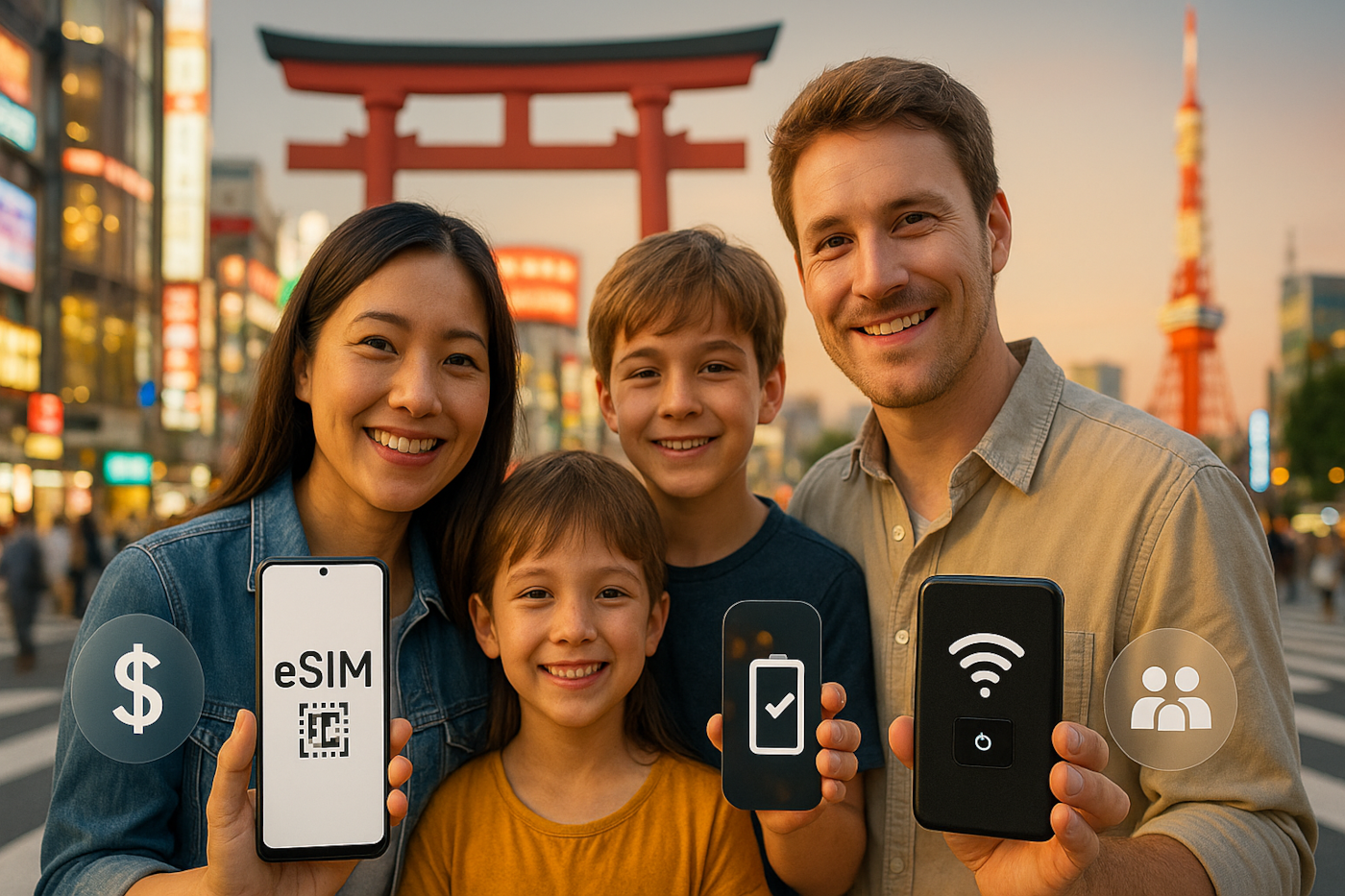
Couples and families: sharing one router brings the per-person cost below most individual eSIM options. The crossover is usually around two people: at that number, pocket WiFi is already competitive, and with three or four people it is clearly cheaper.
A couple on a 10-day trip: one router at approximately ¥8,000 (~$53 / €48) total split two ways = ¥4,000 each (~$27 / €24). Two individual eSIMs at ¥2,480 each = ¥4,960 each (~$33 / €30). The router is already cheaper per person, and it covers both phones, the tablet they share, and any other devices without any additional cost.
Multiple devices or carrier-locked phones: pocket WiFi is the practical option. It connects to any WiFi-capable device regardless of phone model or carrier lock.
Heavy data users: truly unlimited pocket WiFi removes the risk of hitting a speed cap. High-capacity eSIM plans exist but cost more per person than a shared router for two or more travellers.
Is Unlimited Pocket WiFi Worth the Extra Cost?
What Providers Actually Mean by “Unlimited”
Truly unlimited: no daily cap, no throttling. Japan Wireless.
FUP unlimited: high-speed up to a threshold (commonly 3–5GB/day), then throttled to 128kbps until midnight. Ninja WiFi’s “best effort” policy can reduce speeds under heavy use. At 128kbps, Google Maps will not load tiles. Translation apps time out. Booking platforms fail to complete requests.
Fixed daily data: service stops at the cap for the day. Common on budget plans.
When to Pay for Truly Unlimited
If any of these apply to your trip: travelling with a group sharing one router; making video calls regularly; using navigation for most of the day; uploading photos and video to social media daily; working remotely. In these cases, the extra cost over a FUP plan is worth it.
For a solo traveller using maps and messaging without streaming, a 3GB/day FUP plan is usually sufficient and costs less.
To put 3GB/day in context: Google Maps running in the background for 8 hours uses roughly 100–200MB. Google Translate camera mode uses around 5MB per translation. Instagram with moderate scrolling and posting uses 300–500MB per hour. A light day of navigation and messaging sits well under 1GB. A full day of active social media, video calls, and streaming can hit 5–8GB easily.
How to Book and Avoid Paying More Than You Need To
Book Online Before You Arrive
Airport counter rentals cost more and can be out of stock during peak seasons: cherry blossom season (late March to April), Golden Week (late April to May), summer holidays, and New Year. Booking 1–3 weeks in advance secures the device and gives access to online pricing. Japan Wireless coupon code JPW001 gives 20% off: verify it is active before completing payment.
Another reason to book in advance: you can choose your delivery method calmly rather than making the decision at an airport counter after a long-haul flight. Whether you want airport pickup, hotel delivery, or home delivery before you depart, all options are available at booking and none of them are available as an afterthought at 23:00 at Narita.
Airport Pickup vs Hotel Delivery
| Method | Pros | Cons | Best for |
|---|---|---|---|
| Airport post office / partner counter | Connected from the moment you clear customs | Operating hours: confirm for early/late flights | First-time visitors |
| Hotel delivery | Device waiting at check-in | No connection during airport-to-hotel journey | Late arrivals, repeat visitors |
| Home delivery before departure | Everything sorted before you fly | Extra lead time and shipping cost | Frequent travellers |
Japan Wireless airport pickup is at post office counters with specific operating hours. If your flight lands after 20:00, immigration at Narita or Haneda can take 30–60 minutes on a busy evening, and the counter may already be closed by the time you clear. In that case, hotel delivery is the safer choice.
Returning the Device
Japan Wireless: prepaid Japan Post envelope. Drop it in any red letterbox before you clear security on departure day. Letterboxes are at every airport, every convenience store, and on most streets. Post it before going through security: not after.
Which Plan to Choose Based on Your Trip
7-day trip: A standard 4G unlimited plan covers all typical tourist use: maps, translation, social media, messaging, video calls. Expect to pay approximately ¥6,000–¥9,000 (~$40–$60 / €36–€54). Apply JPW001 at checkout.
Most first-time Japan visitors underestimate how much they rely on their connection during the first two days. Navigating from Narita or Haneda to your hotel, finding the right exit at a complex station like Shinjuku, translating the check-in form at a smaller ryokan: all of this happens before you have had a chance to get your bearings. A reliable connection from the moment you clear customs removes most of the friction from those first hours.
If you are travelling solo and your phone is eSIM-compatible and unlocked, run the numbers first. An eSIM for 7 days starts from approximately ¥2,480 (~$17 / €15). If that covers your data habits, it is the lighter and cheaper option. If you have a second device or are sharing with anyone, the router wins.
10–14 day trip: The daily rate improves and truly unlimited data earns its cost over a longer itinerary. Japan Wireless at 14 days: approximately ¥12,430 (~$83 / €74) before discount, ¥9,944 (~$66 / €60) with JPW001.
30-day stay: Look for monthly pricing rather than daily rates. Japan Wireless 30-day rental: ¥20,860 (~$139 / €125). Confirm the provider allows extensions without a penalty.
Families or groups: Prioritise truly unlimited data and battery life. Japan Wireless supports up to 15 simultaneous devices and includes the power bank free. For a family of four on a 30-day rental, the daily per-person rate drops to approximately ¥175 (~$1.15 / €1.05).
One practical note: the router needs to stay with the group for everyone to stay connected. If your family regularly splits into two groups during the day: parents at a temple, teenagers at a shopping district: either rent two routers or give one sub-group a cheap eSIM for the days when you separate.
FAQ: Pocket WiFi Prices in Japan
How much does pocket WiFi cost per day in Japan?
Between ¥440 and ¥4,064 (~$2.95–$27 / €2.65–€24) per day. Japan Wireless starts from $3.6/day on longer rentals. Ninja WiFi starts from ¥440/day. The headline rate is based on the longest available rental: calculate the total for your specific dates before comparing.
Is pocket WiFi cheaper than eSIM in Japan?
For a solo traveller with an eSIM-compatible unlocked phone, an eSIM is usually cheaper. For two or more people sharing one router, pocket WiFi typically works out cheaper than buying individual eSIMs for everyone.
Is pocket WiFi worth it for one person?
Yes if: your phone is carrier-locked; you need to connect a laptop or tablet; you want truly unlimited speed for heavy use; or you prefer not to configure eSIM settings. For a solo traveller with a compatible phone and moderate data use, an eSIM is simpler and cheaper.
How many people can share one pocket WiFi?
Most routers in Japan support 5–15 simultaneous connections. Japan Wireless supports up to 15 devices. Battery drain and bandwidth both decrease with more active connections: practical performance is best with 4–6 devices in simultaneous heavy use.
Are unlimited pocket WiFi plans really unlimited?
Japan Wireless: yes, no daily cap. Ninja WiFi: operates on a “best effort” basis that can reduce speeds under heavy daily use. Always confirm what happens after 3GB of use in a single day before booking.
Do I need insurance?
Not required, but a lost or broken router costs ¥20,000–¥30,000+ (~$133–$200+ / €120–€180+) to replace. Daily insurance at ¥100–¥300 is considerably cheaper than that. Worth adding for family travel, long trips, or anyone doing outdoor activities.
The scenarios where insurance pays for itself: a phone falls into water and the router is in the same pocket; a bag gets stolen at a busy train station; a router screen cracks in a full backpack. None of these are rare events on a multi-week trip. The daily cost of insurance is low enough that most travellers who skip it and then lose the device wish they had added it.
Can I rent pocket WiFi at Narita or Haneda Airport?
Yes. Japan Wireless offers pickup at airport post office counters and partner counters at Narita, Haneda, and Kansai. Confirm the operating hours for your specific arrival time before choosing airport pickup: counters do not stay open all night.
What happens if I return the device late?
Additional daily charges apply. For Japan Wireless, return is by Japan Post letterbox anywhere in Japan. Post it before clearing security on departure day. If you forget and mail it from home, you will be charged for every day between your return date and when Japan Wireless receives it.
Final Thoughts
The daily rate tells you very little on its own. To get the real cost:
- Calculate the total for your specific dates, not the headline figure
- Add delivery, insurance, power bank if not included, and return postage
- Check whether “unlimited” means truly unlimited or subject to throttling
- Divide the total by the number of people sharing the router and compare against individual eSIM costs
- Apply JPW001 at checkout for 20% off Japan Wireless (verify it is active before paying)
For most travellers visiting Japan for 7–14 days with a group or multiple devices, pocket WiFi is the more practical and often cheaper option. For a solo traveller with a compatible phone and light data habits, price an eSIM first.
The single most common mistake is booking based on the headline daily rate without adding up delivery, insurance, and power bank costs. A provider advertising ¥440/day with a ¥200/day power bank add-on and ¥1,000 pickup fee ends up costing more over 14 days than a provider advertising ¥700/day with everything included. Read the checkout total, not the homepage banner.
All prices verified June 2026. Exchange rates: ¥150 = $1 USD / ¥167 = €1 EUR.
👉 Do I Need Pocket WiFi in Japan? Full Comparison Guide