

Last updated on September 24, 2026. Prices include current promotions.
The best eSIM for Japan depends on two things: how long you’re staying and how much data you use each day. For most one- to two-week trips, an unlimited plan is the simplest choice, and Japan Wireless eSIM, Airalo, and Sakura Mobile all offer one. If you only need maps and messaging, a small fixed plan costs a fraction of that. For example, Japan Wireless eSIM’s 3 GB / 7-day plan is $7.70.
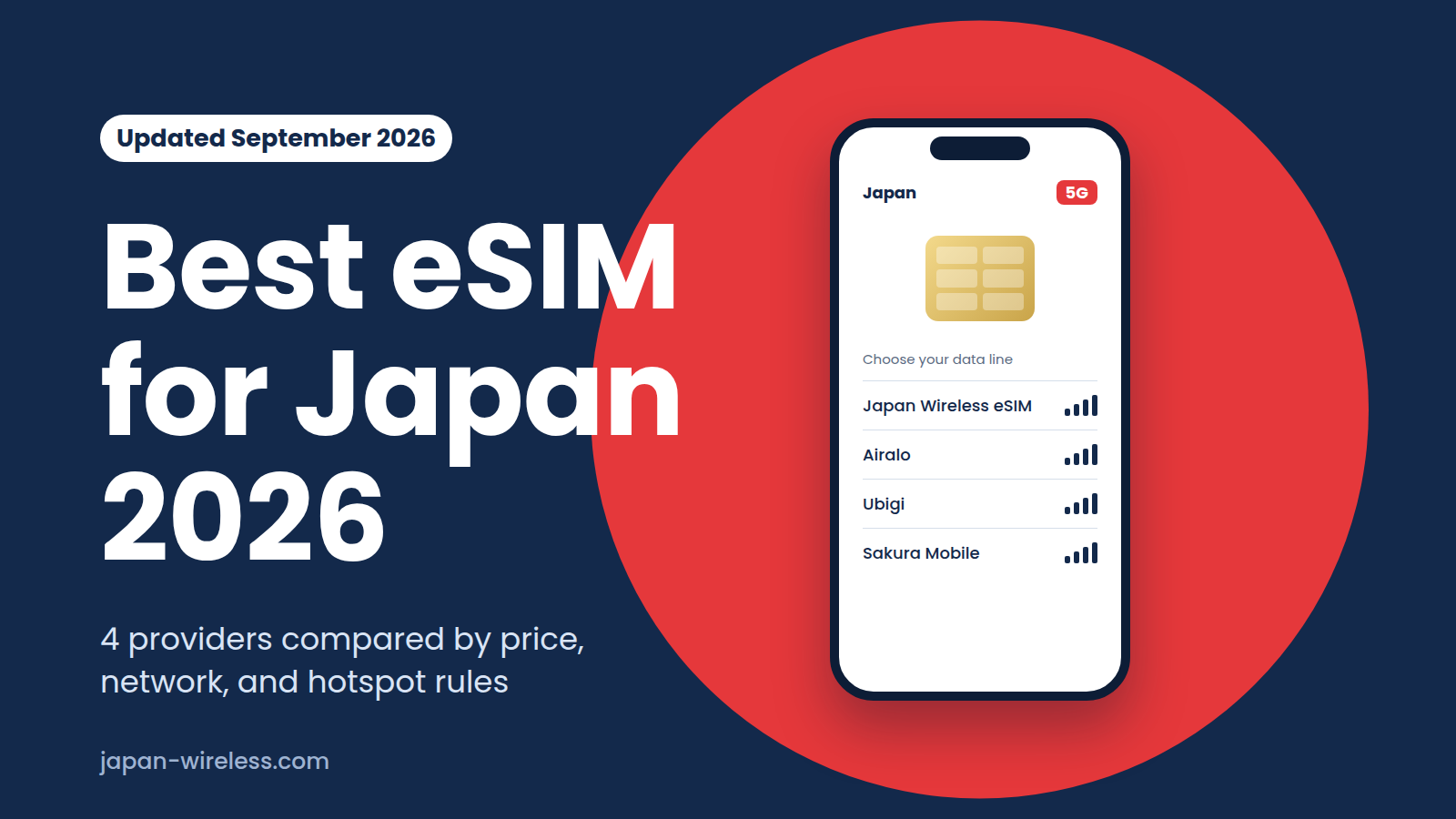
This guide compares the four eSIMs that inbound travelers shortlist most often (Japan Wireless eSIM, Airalo, Ubigi and Sakura Mobile) by price, network, hotspot rules, and support.
We run the Japan Wireless support desk in Tokyo, so we see where eSIM setups go wrong. The most common problem usually isn’t the network. It’s a phone that is still carrier-locked, which no eSIM on this list can fix.
Best eSIM for Japan: quick comparison table (2026)
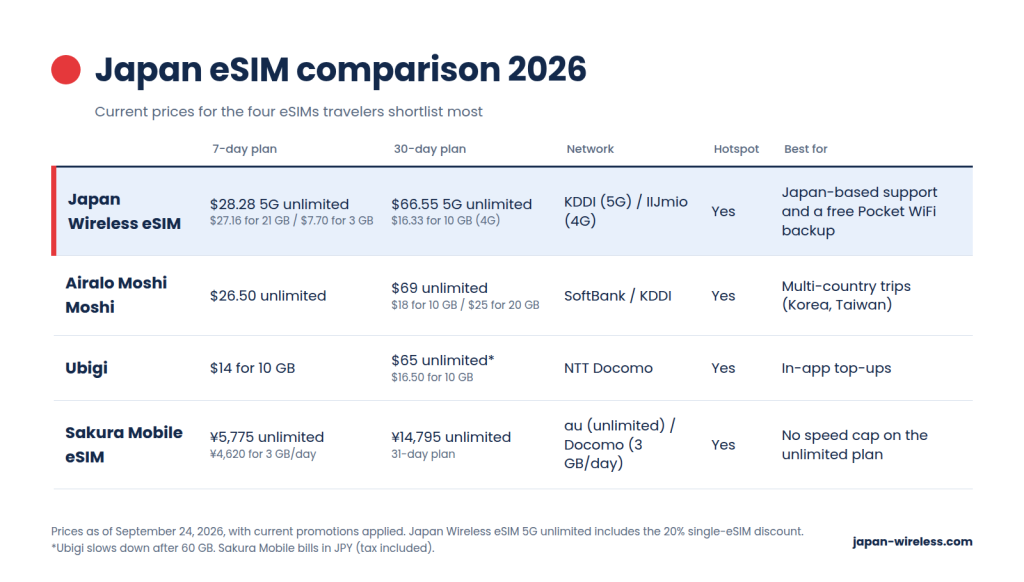
| Provider | 7-day plan | 30-day plan | Network | Hotspot | Key strength |
|---|---|---|---|---|---|
| Japan Wireless eSIM | $28.28 (5G unlimited) $27.16 (21 GB, 5G) $7.70 (3 GB, 4G) | $66.55 (5G unlimited) $16.33 (10 GB, 4G) | KDDI (5G plans) / IIJmio (4G plans) | Yes | Japan-based support by phone, chat and email, plus a free Pocket WiFi backup |
| Airalo Moshi Moshi | $26.50 (unlimited) | $69 (unlimited) $18 (10 GB) $25 (20 GB) | SoftBank / KDDI | Yes | Regional plans if you continue on to Korea or Taiwan |
| Ubigi | $14 (10 GB) | $65 (unlimited, slows after 60 GB) $16.50 (10 GB) | NTT Docomo | Yes | In-app top-ups |
| Sakura Mobile eSIM | ¥5,775 (unlimited) ¥4,620 (3 GB/day) | ¥14,795 (unlimited, 31 days) | au (unlimited) / NTT Docomo (3 GB/day) | Yes | No speed cap on the unlimited plan |
Prices are as of September 24, 2026, and include current promotions. Japan Wireless eSIM’s 5G unlimited prices include a 20% discount for single-eSIM orders (regular prices are $35.35 for 7 days and $83.19 for 30 days). Sakura Mobile bills in Japanese yen, and its prices here include tax.
Which eSIM is best for your trip to Japan?
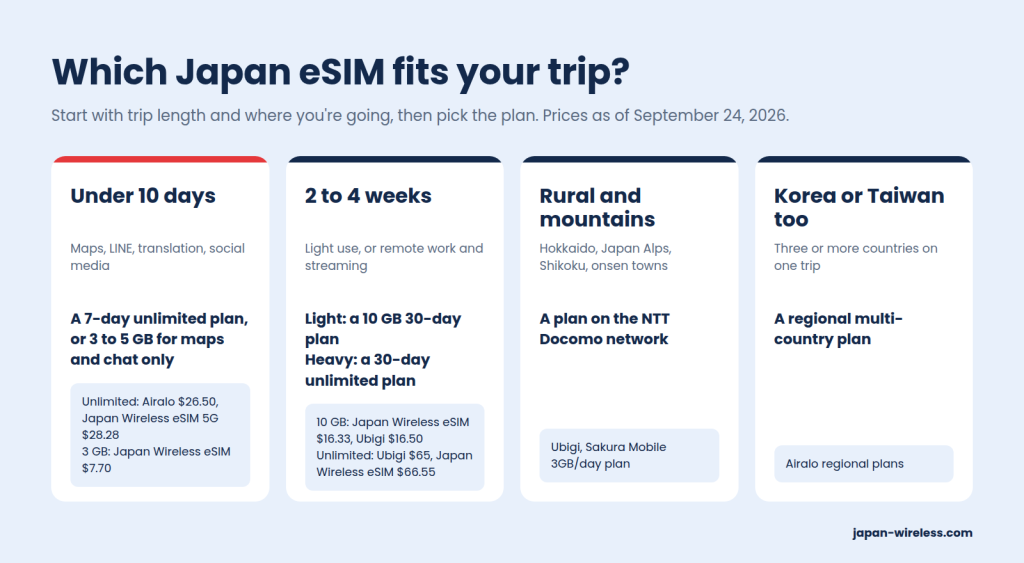
Short trips under 10 days
A typical day of Google Maps, translation, LINE and some social media uses up to about 1 GB. Over a week, that adds up to about 3.5–7 GB. If that’s all you need, Japan Wireless eSIM’s 3 GB plan ($7.70) or 5 GB plan ($10.30) for 7 days is the cheapest option in this comparison.
If you upload photos, stream video, or don’t want to watch your usage, a 7-day unlimited plan removes the guesswork. Airalo ($26.50) and Japan Wireless eSIM’s 5G plan ($28.28) cost about the same. If you’d like more than a small plan without paying for unlimited data, Ubigi’s 10 GB plan ($14) is a middle option.
Trips of 2–4 weeks
For light users, a 10 GB plan valid for 30 days is usually enough. Japan Wireless eSIM ($16.33, 4G) and Ubigi ($16.50) are the cheapest here, and Airalo’s 20 GB plan ($25) gives more room.
If you work remotely, stream video, or share a hotspot with a travel partner, a 30-day unlimited plan usually costs less than several top-ups. Ubigi ($65) is the cheapest, but it slows down after 60 GB. Japan Wireless eSIM’s 5G plan ($66.55) and Airalo ($69) come next. Sakura Mobile’s unlimited plan (¥14,795 for 31 days) costs more but has no speed cap.
Rural and mountain travel
NTT Docomo generally has the widest coverage in Hokkaido, the Japan Alps, and Shikoku. Ubigi and Sakura Mobile’s 3 GB/day plan both run on Docomo. The KDDI (au) network used by Japan Wireless eSIM’s 5G plans and Sakura Mobile’s unlimited plan also covers most of the country well. SoftBank, which Airalo uses alongside KDDI, can be weaker in remote onsen towns.
Trips that include Korea or Taiwan
Airalo’s regional plans can make sense if you visit three or more countries on one trip. For a Japan-only trip, a Japan-specific plan is usually simpler. If your next stop is Korea or Taiwan, you might also look at Gmobile, our sister service, which offers a Korea eSIM and a Taiwan eSIM.
How much data do you need for 10, 14 or 21 days?
| Trip length | Light use | Typical use with margin |
|---|---|---|
| 10 days | about 5 GB | about 10 GB |
| 14 days | about 7 GB | about 14 GB |
| 21 days | about 10 GB | about 21 GB |
A rough guide is 0.5–1 GB per day for maps, messaging, and social media. Heavy video use or hotspot sharing can double these figures, and that’s when an unlimited plan starts to pay off.
For a breakdown by app and trip length, see our guide on how much data you need in Japan. If you want to compare cost per gigabyte, we also have a separate Japan eSIM cost-per-GB comparison.
Activation and phone compatibility
All four eSIMs need an unlocked, eSIM-compatible phone. In general, that means an iPhone XR, XS or newer, a Google Pixel 4 or newer, or a Samsung Galaxy S20 or newer. If you bought your phone through a carrier, check the lock status before you buy. Our guide on using a carrier-locked phone in Japan explains the options, and the complete list of eSIM-capable devices covers specific models.
It’s best to buy the eSIM before your trip and install it after you arrive in Japan, using the free Wi-Fi at the airport. Japan Wireless eSIM shows the QR code on screen right after purchase and also emails it to you, so it helps to keep the email open on a second device, such as a laptop or a travel partner’s phone, for scanning. For step-by-step setup on iPhone and Android, see our Japan eSIM guide.
Your home SIM can stay active for calls and two-factor authentication codes while the Japan eSIM handles data. You can set this up in your phone’s cellular settings. If the connection doesn’t work after landing, our Japan eSIM troubleshooting guide covers the usual fixes.
What to check before buying
“Unlimited” doesn’t always mean unlimited speed
Unlimited plans handle heavy use differently. Ubigi’s 30-day unlimited plan slows down after 60 GB. Sakura Mobile’s 3 GB/day plan drops to 200 kbps once you pass 3 GB in a day, while its separate unlimited plan has no speed cap. Japan Wireless eSIM’s 5G unlimited plan has no daily cap, but extremely heavy use may be subject to its fair usage policy. The terms tell you more than the plan name does.
Hotspot allowances
All four providers allow hotspot use, but some set a separate limit. Japan Wireless eSIM’s 5G unlimited plans and Sakura Mobile’s unlimited plan each include a set amount of high-speed hotspot data (for example, 6 GB on Sakura’s 7-day plan). After that, hotspot sharing still works at a lower speed.
Voice and SMS
None of the four eSIMs include a Japanese phone number. For restaurant reservations or other services that need a local number, a voice SIM such as Mobal’s is a better fit.
Refunds and cancellations
Most Japan eSIM plans can’t be refunded once they’re purchased. Japan Wireless eSIM lists its plans as non-refundable, and Airalo doesn’t refund a plan once you scan the QR code. Confirm your travel dates and phone compatibility before you buy.
Payment and currency
Japan Wireless eSIM, Airalo, and Ubigi show prices in USD, and Sakura Mobile charges in Japanese yen. Depending on your card, a foreign transaction fee of 1–3% might apply.
Support when something goes wrong
This is the point that rarely shows up in price tables. Japan Wireless eSIM offers English support from Japan seven days a week by chat, email, and phone. If the eSIM still can’t connect after guided checks and your phone is compatible, Japan Wireless ships a free Pocket WiFi to your hotel. Global marketplaces usually offer chat support only, and time zones can cause delays.
Frequently Asked Questions
- What is the best eSIM for Japan?
-
It depends on how you use data. For light users, Japan Wireless eSIM’s 3 GB and 5 GB 7-day plans are the cheapest in this comparison. For a one-week trip, a 7-day unlimited plan from Airalo ($26.50) or Japan Wireless eSIM ($28.28) is the simplest choice. For long stays with heavy use, Ubigi’s 30-day unlimited plan ($65) is the cheapest, and Sakura Mobile’s unlimited plan is the only one here without a speed cap.
- How much data do I need for a 7-day trip to Japan?
-
Most travelers use about 7 GB in a week, or about 3.5 GB if they mainly use maps and messaging. A 10 GB plan or larger gives you some margin, and an unlimited plan makes sense if you stream video on the Shinkansen. Video calls use the most data. A 30-minute FaceTime call can use about 500 MB or more.
- Can I use an eSIM and my home SIM at the same time?
-
Yes. This works on any iPhone XR, XS or newer and on most Android phones from 2020 onward. The Japan eSIM becomes your data line, and your home SIM stays active for calls and SMS codes. Turning off data roaming on the home line helps you avoid daily roaming charges from your home carrier.
- Does Japan Wireless eSIM work on the Shinkansen and in rural areas?
-
Yes. Japan Wireless eSIM’s 5G plans run on KDDI (au), one of Japan’s three major networks, which covers the main Shinkansen routes, including the Tokaido, Sanyo, and Tohoku lines. Long tunnels can still cause short drops on any network. For deep-rural areas in Hokkaido or the Kii Peninsula, a Docomo-based plan might have a slight edge.
- Is Airalo or Japan Wireless eSIM cheaper for Japan?
-
It depends on the plan. For 7-day unlimited data, Airalo is slightly cheaper ($26.50 vs. $28.28). For 30-day unlimited data, Japan Wireless eSIM is cheaper ($66.55 vs. $69). For small fixed plans, Japan Wireless eSIM’s 3 GB/7-day plan costs $7.70. For a detailed breakdown, see Japan Wireless vs Airalo eSIM.
- Can I use my eSIM as a hotspot in Japan?
-
Yes. All four providers in this guide allow hotspot use in 2026. Some unlimited plans, including Japan Wireless eSIM’s 5G unlimited and Sakura Mobile’s unlimited plan, include a set amount of high-speed hotspot data. A laptop on a hotspot typically uses 1–2 GB per hour of active browsing, which is worth keeping in mind if you plan to work from a café.
- When should I install the eSIM, before or after arriving in Japan?
-
After you arrive. It’s best to buy the eSIM before your trip and install it once you land, using the free Wi-Fi at Narita, Haneda or Kansai. After installing, turning on Data Roaming for the Japan line and selecting it for Cellular Data completes the setup. Our Japan eSIM guide walks through each step.