

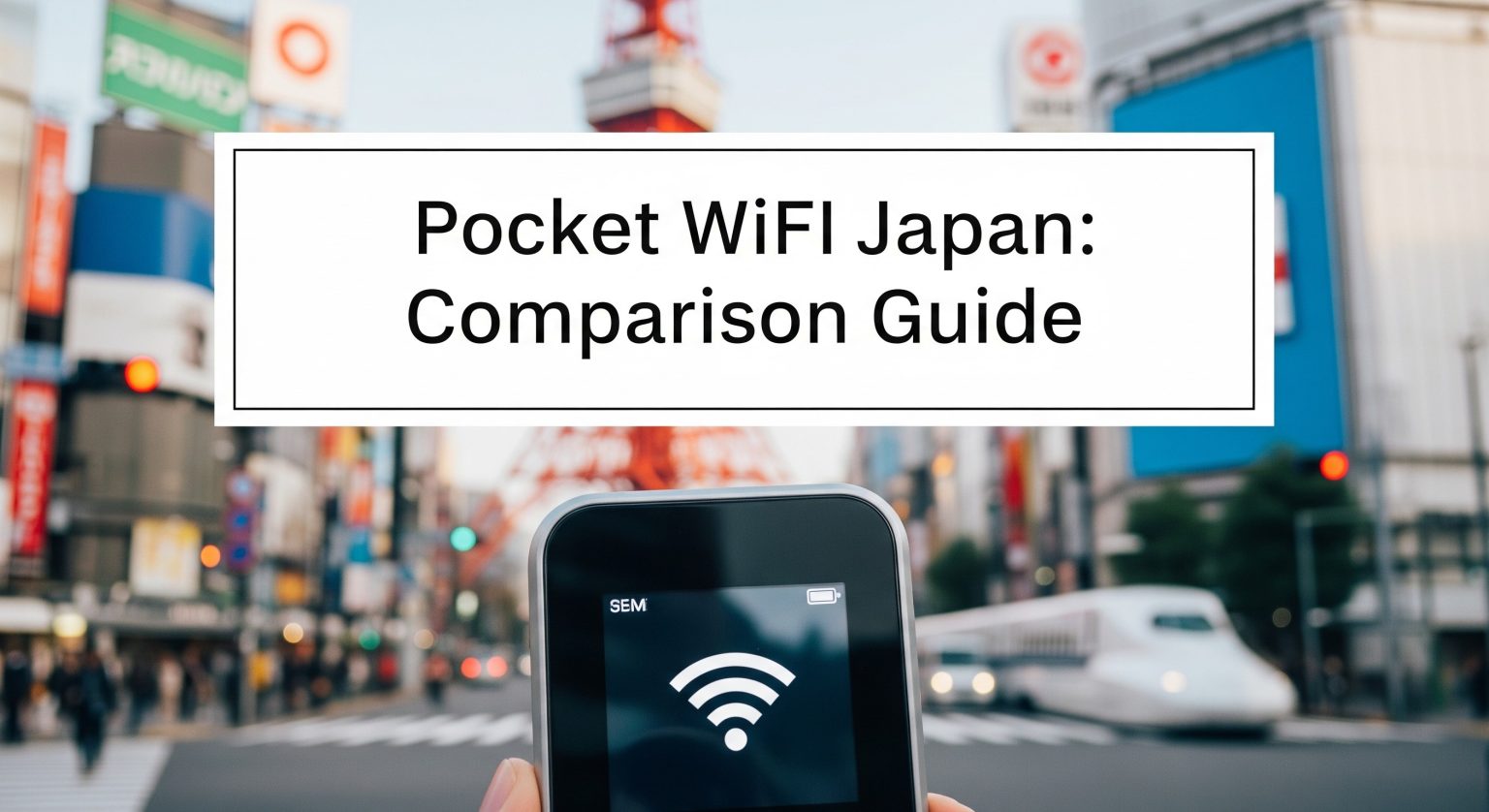
When planning a trip to Japan, two names come up repeatedly among international travellers researching pocket WiFi: Ninja WiFi and Japan Wireless. Both serve English-speaking visitors well, but in different ways. Ninja WiFi is known for its airport counter convenience and flexible data plans. Japan Wireless is known for truly unlimited data, a free power bank, and better overall value for heavy users and groups.
This comparison covers price, data, battery, pickup, return, coverage, and support. The goal is a clear answer, not a recommendation with a commission attached.
Ninja WiFi vs Japan Wireless: Quick Verdict
If you want truly unlimited data, a free power bank, and the best value for heavy internet use or group travel, Japan Wireless is the stronger choice. If you want to pick up your device directly at a dedicated airport counter the moment you land, or prefer flexible daily data plans for a short trip, Ninja WiFi is the easier option.
Japan Wireless is built around data. Ninja WiFi is built around airport logistics.
Choose Japan Wireless if you want unlimited data, longer battery life, and better value
Japan Wireless suits travellers who use their phones heavily throughout the day and want to share the connection across multiple devices without worrying about data caps.
Travellers who heavily use Google Maps, translation apps, Instagram, TikTok, YouTube, and video calls will benefit from Japan Wireless’s truly unlimited data plan, which has no daily high-speed cap and no Fair Usage Policy throttling. With three or four devices sharing one router, data consumption multiplies fast. Japan Wireless includes a free power bank with every rental, which is essential when the router is sharing battery strain across multiple connections throughout a full day of sightseeing. The longer your trip, the more cost-effective Japan Wireless becomes per day.
Choose Ninja WiFi if you prioritise airport counter pickup and flexible daily plans
Ninja WiFi suits travellers who value the ease of walking off the plane and collecting their device at a dedicated, staffed counter without any prior coordination.
Ninja WiFi operates dedicated counters at Narita, Haneda, and Kansai airports, plus smart pickup lockers that remain accessible when staffed counters are closed. For late arrivals or early departures, Ninja WiFi’s locker system is genuinely useful. Their plan range, from 1GB/day through to unlimited options, also suits short-trip travellers who want to pay only for the data they need rather than a blanket unlimited rate.
Quick comparison by traveler type
| Traveler type | Better choice | Why |
|---|---|---|
| Solo short trip (under 7 days) | Either | Depends on pickup preference and data use |
| Family or group | Japan Wireless | No daily cap when sharing across multiple devices |
| Heavy data user | Japan Wireless | Truly unlimited, no throttling |
| Airport pickup priority | Ninja WiFi | Dedicated counters and smart lockers |
| Long-term stay (2+ weeks) | Japan Wireless | Better cost-performance over time |
| Late-night or early-morning arrival | Ninja WiFi | 24-hour locker access |
| All-day sightseeing | Japan Wireless | Free power bank included |
Ninja WiFi vs Japan Wireless Comparison Table
Prices verified June 2026. Always confirm current rates on provider websites before booking.
| Category | Japan Wireless | Ninja WiFi | Better for |
|---|---|---|---|
| Daily price (standard) | from ~¥623/day (~$4.15/€3.75) | from ¥440/day (~$2.95/€2.65) unlimited | Ninja WiFi on daily rate |
| 14-day total (unlimited) | ~¥9,000–¥10,000 (~$60–$67/€54–€60) | ~¥12,000–¥13,000 (~$80–$87/€72–€78) | Japan Wireless |
| Data allowance | Truly unlimited (no FUP) | Unlimited with “best effort” policy | Japan Wireless |
| Speed | 4G LTE / 5G | 4G LTE / 5G | Tie |
| Network | SoftBank / au | SoftBank | Tie |
| Battery life | ~10–20 hrs depending on model | ~10–12 hrs | Japan Wireless |
| Power bank | Included free | Paid add-on (~¥110–200/day) | Japan Wireless |
| Devices connected | Up to 10–15 | Up to 5–10 | Japan Wireless |
| Airport pickup | Post office / partner counter | Dedicated counter + smart locker | Ninja WiFi |
| Hotel delivery | Yes | Yes | Tie |
| Return method | Prepaid envelope, any mailbox | Airport counter / return box | Tie |
| English support | Email / phone | Email / phone / counter staff | Tie |
| Insurance option | Yes (add-on) | Yes (full coverage option) | Ninja WiFi |
| Coupon code | JPW001 (20% off) | N/A for standard booking | Japan Wireless |
Price and daily rental cost
The daily headline rate favours Ninja WiFi, which starts at ¥440/day (~$2.95/€2.65) for their unlimited plan. Japan Wireless starts at around ¥623/day (~$4.15/€3.75). However, the total cost picture shifts when you factor in add-ons.
Japan Wireless includes the power bank free of charge. Ninja WiFi charges approximately ¥110–200/day for a power bank rental. On a 14-day trip where you rent a power bank from Ninja WiFi, that adds ¥1,540–¥2,800 (~$10–$19/€9–€17) to the total, which largely closes the per-day gap. Japan Wireless also offers a 20% discount with coupon code JPW001, which further improves its value at checkout.
Data limits and speed
This is the most important practical difference between the two providers.
Japan Wireless offers genuinely unlimited data with no daily Fair Usage Policy cap. You can use 20GB in a day without experiencing speed throttling.
Ninja WiFi’s unlimited plan operates on what their terms describe as a “best effort” basis. This means data transmission rates can be subject to slowing if usage is deemed excessive by the underlying network. In practical terms for most travellers, this functions fine for standard use. For families sharing one connection or travellers doing frequent video calls and cloud uploads, Japan Wireless’s harder commitment to no throttling offers more predictable performance.
Coverage
Both Ninja WiFi and Japan Wireless use SoftBank as their primary network. Japan Wireless also utilises au (KDDI) depending on the router model allocated. SoftBank covers 99% of Japan’s populated areas and performs excellently across all major tourist circuits.
In very remote mountain areas, deep rural Hokkaido, or areas far from populated centers, the Docomo and au networks have historically provided marginally more resilient coverage. Since Japan Wireless has access to au on certain routers, it may have a small advantage in these edge cases, though neither provider can guarantee connectivity in truly remote locations.
Battery life and power bank
Pocket WiFi devices typically deliver 5–12 hours of active use depending on the model, number of connected devices, signal strength, and temperature. Both providers are in a similar range on the device itself.
The differentiator is the free power bank from Japan Wireless. This effectively doubles your available usage time for a full day of sightseeing, included in the rental. Ninja WiFi offers a power bank as a paid add-on, which is a reasonable option but requires you to remember to add it during booking.
For travellers leaving the hotel at 8AM and returning after dinner, the free power bank is a meaningful practical advantage.
Pickup and return
Ninja WiFi operates dedicated, clearly signposted counters at major Japanese airports including Narita, Haneda, and Kansai. Their smart pickup lockers are available outside staffed counter hours, which is genuinely useful for late-night arrivals. Return is at airport counters or drop boxes.
Japan Wireless does not have its own branded airport counters. Pickup is at Airport Post Office counters or partner counters during their operating hours. For flights arriving after hours, Japan Wireless strongly recommends hotel delivery, where the router arrives at your accommodation before you do. Return is via a prepaid envelope dropped into any red Japan Post mailbox anywhere in Japan, including inside airport terminals. This is a very convenient return method.
English support
Both companies provide English-language support. Ninja WiFi has an advantage in the airport context: English-speaking staff at counters can assist immediately if your phone does not connect to the router. Japan Wireless provides responsive English support via email and phone during business hours.
Plans and Prices: Which Is More Cost-Effective?
Japan Wireless pricing
Japan Wireless offers one main plan: truly unlimited data. Pricing scales favourably with duration. A 7-day rental costs approximately ¥4,200–¥5,500 (~$28–$37/€25–$33). A 14-day rental runs approximately ¥9,000–¥10,000 (~$60–$67/€54–€60). A 30-day rental is approximately ¥15,000–¥20,000 (~$100–$133/€90–€120). The power bank is included in all rentals for free. Use coupon code JPW001 for 20% off at checkout.
Ninja WiFi pricing
Ninja WiFi offers multiple plans: 1GB/day, 3GB/day, 5GB/day, 10GB/day, and unlimited. Their unlimited plan starts from ¥440/day (~$2.95/€2.65). For a 7-day rental their base unlimited rate is approximately ¥3,080 (~$20.55/€18.55), and for 14 days approximately ¥6,160 (~$41/€37). Adding a power bank at ¥110–200/day adds ¥770–¥2,800 (~$5–$19/€5–€17) to those totals across 7–14 days.
Cost comparison by trip length
Prices are approximate estimates based on June 2026 published rates. Always verify totals on provider websites before booking.
| Trip length | Japan Wireless (unlimited + free power bank) | Ninja WiFi (unlimited + paid power bank est.) | Difference |
|---|---|---|---|
| 7 days | ~¥4,200–¥5,500 (~$28–$37/€25–€33) | ~¥3,850–¥4,480 (~$26–$30/€23–€27) | Similar |
| 14 days | ~¥9,000–¥10,000 (~$60–$67/€54–€60) | ~¥7,700–¥9,000 (~$51–$60/€46–€54) | Similar–slight Japan Wireless advantage |
| 30 days | ~¥15,000–¥20,000 (~$100–$133/€90–€120) | ~¥15,400–¥19,200 (~$103–$128/€93–€115) | Comparable |
The gap narrows significantly once power bank costs are included for Ninja WiFi. For heavy users who need the power bank every day, Japan Wireless is at least comparable in total cost and delivers more predictable data performance.
Data Usage and Speed: Which Is Better for Heavy Use?
For standard tourist use, including maps, messaging, and occasional social media, both providers are more than adequate. The difference shows in heavier use scenarios.
Japan Wireless: unlimited with no daily cap
Japan Wireless’s Premium WiFi plan has no daily high-speed data cap and no Fair Usage Policy throttling. Families streaming video, travellers uploading large photo and video files, and remote workers on video calls can use as much data as needed without hitting a speed wall.
Ninja WiFi: unlimited with best-effort policy
Ninja WiFi’s unlimited plan operates on a best-effort basis: speeds may be reduced if usage is deemed excessive by the network. For most solo travellers using maps, messaging, and social media, this works without issue. For heavier use cases, particularly groups sharing one connection, the lack of an explicit unlimited commitment introduces uncertainty.
Use case guide
| Use case | Better choice | Notes |
|---|---|---|
| Google Maps and messaging | Either | Low data; both handle this comfortably |
| Translation apps | Either | Stability matters more than volume |
| Instagram and TikTok uploads | Japan Wireless | Video uploads are data-intensive |
| Video calls (Zoom, FaceTime) | Japan Wireless | Heavy continuous data; risk of throttle mid-call |
| Streaming (Netflix, YouTube) | Japan Wireless | High data; no cap is important |
| Light solo travel | Either | Choose based on pickup preference |
Coverage: Tokyo, Kyoto, Osaka, Rural Areas, and Ski Resorts
Major cities
Both providers deliver fast, reliable 4G/5G coverage throughout Tokyo, Osaka, Kyoto, Hiroshima, Fukuoka, and all major tourist circuits. Coverage is not a meaningful differentiator for travellers staying on the standard tourist route.
Rural Japan and ski resorts
If your itinerary includes remote onsen towns, ski resorts in Hokkaido or Nagano, or rural driving routes, check the provider’s coverage map for your specific destinations before booking. Japan Wireless’s access to the au/KDDI network on certain router models gives it a potential advantage in areas where SoftBank’s reach is thinner. Neither provider can guarantee connectivity in truly remote or mountainous locations.
If the trip centers on rural areas or ski resorts, Japan Wireless is worth prioritising based on network diversity, though in practice both will cover the major resort and tourist areas without issue.
First-time visitors to major cities
For first-time visitors staying in Tokyo, Kyoto, and Osaka, coverage is not a concern with either provider. In this case, make your decision based on price, battery, and pickup logistics rather than network differences.
Battery Life and Device Usability
Japan Wireless
Japan Wireless devices typically run for 10–20 hours depending on the model and number of connected devices. The critical advantage is the free power bank included with every rental. For a group of three or four sharing one router and using maps, translation, and messaging throughout the day, the device battery drains faster than solo use. The power bank ensures you stay connected through a full day without returning to the hotel to charge.
Ninja WiFi
Ninja WiFi provides modern devices with touchscreen interfaces and standard battery life of approximately 10–12 hours. A power bank is available as a paid add-on. If you do not add it during booking, you may need to plan around battery life on longer days.
All-day sightseeing verdict
For travellers spending 12+ hours out exploring, Japan Wireless is the more reliable choice because the free power bank removes a logistical concern. Ninja WiFi can match this with a paid power bank add-on, but it requires an additional step and cost.
Pickup and Return
Ninja WiFi
Ninja WiFi operates the most the largest airport counter network of any pocket WiFi provider in Japan. Their dedicated counters at Narita, Haneda, Kansai, and other airports are staffed, clearly signposted, and easy to locate after clearing customs. Smart pickup lockers extend availability beyond staffed counter hours, making Ninja WiFi the best option for late-night arrivals or very early departures. Return is at airport counters or dedicated return boxes.
Japan Wireless
Japan Wireless pickup is at Airport Post Office counters or partner counters, which have operating hours that may not align with late-night or early-morning flights. Hotel delivery is the recommended alternative and means the device is waiting at your hotel front desk when you check in. For most travellers, this is seamless. For travellers arriving late at night who want internet before reaching their hotel, Ninja WiFi has a clear advantage.
Return is via a prepaid envelope dropped into any Japan Post mailbox, which can be found at airports, convenience stores, train stations, and on most street corners throughout Japan. This is one of the easiest return methods in the category.
Which is easier for late-night arrivals or early departures?
If your flight arrives after Airport Post Office closing time, choose Ninja WiFi and use their smart locker, or choose Japan Wireless with hotel delivery pre-arranged. Trying to pick up from Japan Wireless’s airport counter on a 1AM arrival without hotel delivery confirmed in advance is not recommended.
Customer Support and Troubleshooting
Both companies provide English-language support via email and phone. Ninja WiFi has an advantage in the airport arrival context: English-speaking counter staff can resolve connection issues face to face immediately. Japan Wireless provides responsive remote support, and if the eSIM or device fails, they can arrange a replacement.
If your pocket WiFi stops working at any point during your trip, try these steps before contacting support:
- Restart the device by holding the power button until it cycles off and on.
- Check the battery level and connect to the power bank if low.
- Move to a different location. Signal can be blocked by thick concrete walls or underground stations.
- Check that you have not exceeded the maximum number of connected devices.
- If none of the above resolves it, connect to hotel or cafe WiFi and contact your provider’s English support line.
Ninja WiFi vs Japan Wireless by Traveler Type
Solo travellers
For solo trips under 7 days with light data use, Ninja WiFi’s lower-tier plans are cost-effective and airport pickup is seamless. For solo trips over 7 days, or for heavy data users who stream and upload regularly, Japan Wireless offers better value and data freedom.
Couples and families
Japan Wireless is the stronger choice for multiple people sharing one router. Data usage multiplies quickly with two, three, or four devices connected, and the unlimited plan without throttling means no one hits a speed wall mid-trip. The free power bank handles the increased battery drain from multiple connections.
Remote workers and digital nomads
Japan Wireless is the better choice for anyone working remotely from Japan. Video meetings, file uploads, Slack, and cloud sync consume significant data. Japan Wireless’s lack of a daily cap removes the risk of throttling during a morning of calls. The free power bank also helps if you are working from cafes and trains rather than a fixed desk.
Long-term stays (2 weeks or more)
Japan Wireless becomes increasingly cost-effective over longer rental periods. For a 30-day stay, the daily rate difference between providers largely disappears once Ninja WiFi’s power bank add-on is included, and Japan Wireless’s unlimited plan delivers more consistent performance.
Rural travel and ski resorts
Both providers will work in major ski resorts and most popular rural destinations. Check the specific coverage map for your destinations before booking. Japan Wireless’s access to the au network on certain routers gives it a marginal advantage in remote areas. The free power bank is an added practical benefit when cold temperatures can drain batteries faster than usual.
Where Sakura Mobile Fits In
Sakura Mobile is a third provider worth mentioning in this context.
When Sakura Mobile may be worth considering
Sakura Mobile is a strong option for travellers looking at SIM cards or eSIMs rather than pocket WiFi, or for long-term visitors who need a Japanese phone number with a voice and data plan. Their 5G eSIM plans offer genuinely unlimited data with no daily cap, which competes directly with Japan Wireless for heavy data users. For travellers specifically comparing pocket WiFi providers for a standard tourist trip, Ninja WiFi and Japan Wireless remain the primary options.
Why this comparison focuses on Ninja WiFi vs Japan Wireless
The search intent behind “Ninja WiFi vs Japan Wireless” reflects travellers who have already decided on pocket WiFi and are making a final choice between these two specific providers. Sakura Mobile is a meaningful alternative in the broader connectivity landscape but is less directly relevant to this specific comparison.
FAQ: Ninja WiFi vs Japan Wireless
Is Japan Wireless cheaper than Ninja WiFi?
It depends on the trip length and whether you include a power bank. On headline daily rate alone, Ninja WiFi starts cheaper. Once you add Ninja WiFi’s power bank rental for a 14-day trip, the total costs become comparable, and Japan Wireless’s 20% coupon code (JPW001) further narrows the gap. Always compare total all-in costs for your specific trip duration.
Does Japan Wireless have truly unlimited data?
Yes. Japan Wireless’s Premium WiFi plan has no daily high-speed data cap and no Fair Usage Policy throttling. Data is genuinely unlimited regardless of daily usage volume.
Does Ninja WiFi throttle speed after heavy use?
Ninja WiFi’s unlimited plan operates on a “best effort” basis, which means the underlying network can reduce speeds if usage is considered excessive. Most travellers will not experience issues, but the commitment is not equivalent to Japan Wireless’s no-cap guarantee.
Which has better battery life?
Both devices deliver approximately 10–12 hours of battery life. Japan Wireless includes a free power bank with every rental, which extends effective usage through a full day without returning to the hotel. Ninja WiFi offers a power bank as a paid add-on at approximately ¥110–200/day (~$0.75–$1.35/€0.65–€1.20).
Which is easier to pick up at Narita, Haneda, or Kansai Airport?
Ninja WiFi. They operate dedicated, clearly marked counters at major airports plus smart lockers for out-of-hours arrivals. Japan Wireless pickup is at Airport Post Office counters, which have limited operating hours, making hotel delivery the better option for late or early flights.
Which is better for families sharing multiple devices?
Japan Wireless. Multiple devices connected simultaneously drain data faster. Japan Wireless’s truly unlimited plan without a daily cap ensures no one gets throttled mid-trip. The free power bank also handles the increased battery drain from group use.
Which is better for a 2-week Japan trip?
Japan Wireless. Over 14 days, the total cost difference is small once Ninja WiFi’s power bank add-on is included. Japan Wireless delivers more consistent data performance and the 20% coupon makes it competitive on price.
Can I return the pocket WiFi from a different location?
Both work for this. Ninja WiFi allows returns at any of their airport counters. Japan Wireless returns are by prepaid envelope dropped into any Japan Post mailbox in Japan, including at any airport, which works regardless of which airport you depart from.
Final Verdict: Ninja WiFi or Japan Wireless?
Overall recommendation
Japan Wireless is the better choice for most travellers planning a standard Japan trip of one week or more, particularly for anyone who uses data heavily, travels in a group, or wants the convenience of a free power bank without additional booking steps.
Ninja WiFi is the better choice for travellers who prioritise dedicated airport counter pickup, arrive on late-night or early-morning flights, or want the flexibility of choosing a smaller daily data plan for a short trip with light usage.
Neither provider is objectively superior. The right choice depends on how you travel and what matters most to you on the ground.
When Japan Wireless is the better choice
- You want truly unlimited data with no daily cap or throttling risk
- You are traveling with family, friends, or a group sharing one device
- Your trip is 10 days or longer
- You want the free power bank included without extra cost
- You prefer returning the device by dropping an envelope in any mailbox
- You want to use coupon code JPW001 for 20% off
When Ninja WiFi is the better choice
- You want to collect your device at a dedicated airport counter immediately on arrival
- Your flight arrives late at night or departs very early, requiring locker access
- You are on a short solo trip with predictable light data use
- You want to purchase full-coverage loss and damage insurance
- You prefer the flexibility of paying only for the daily data tier you need